

Investing in AI (artificial intelligence) startups can feel like stepping into a gold rush — full of promise, risk, and uncertainty. For most small investors, it seems like the domain of well‑heeled VCs or big funds. But today, there are paths — indirect and direct — for smaller players to get exposure to AI innovation.
In this post, I’ll walk you through how to invest in AI startups when you don’t have millions to deploy. We’ll cover why AI is compelling, routes to participate, due diligence steps, portfolio strategies, risks and challenges, and practical tips to get started. Think of this as your roadmap — one you can revisit as your sophistication grows.
Why Consider Investing in AI Startups?
Before jumping into how, let’s understand why you might want to.
- Rapid growth tailwinds: AI is reshaping industries — from healthcare to legal, fintech to autonomous systems. The pace of adoption is accelerating.
- Asymmetric payoff potential: Early-stage bets occasionally yield 10×, 50×, or even 100× returns if you pick a winner.
- Diversification beyond public markets: Many AI breakthroughs occur in early or private ventures. Getting exposure there gives you more optionality beyond just buying big tech stocks.
- Intellectual engagement & network: Beyond returns, investing in startups lets you be closer to innovation, meet founders, and understand frontier tech up close.
However — and this is important — the path is laden with risk. A large majority of startups fail, especially in deeptech and AI where execution is hard. But with care, discipline, and realistic expectations, small investors can play too.

Paths (Indirect & Direct) for Small Investors
Because small investors can’t reliably deploy millions into private deals, let’s break down both indirect and direct entry strategies.
Indirect Approaches (Lower Barrier, More Liquidity)
These are safer, more liquid, and require less hands‑on work. They won’t deliver unicorn returns from a single deal, but they let you participate in the upside of AI broadly.
- AI / Technology ETFs & Thematic Funds
You can invest in exchange-traded funds (ETFs) or mutual funds that focus on companies heavily exposed to AI (software, semiconductors, cloud, robotics).
- Examples: Global X Artificial Intelligence & Technology (AIQ), ROBO Global, ARK’s robotics/AI ETFs. The Income Informer+2techpulsion.com+2
- Pros: diversified exposure, low friction, easier to buy/sell
- Cons: You’re one step removed from pure startup upside, and large fund flows can sway performance
- Examples: Global X Artificial Intelligence & Technology (AIQ), ROBO Global, ARK’s robotics/AI ETFs. The Income Informer+2techpulsion.com+2
- Public Companies & Big-Tech AI Leaders
You can pick shares in companies that lead in AI — such as NVIDIA, Alphabet (Google), Microsoft, OpenAI‑adjacent firms, cloud providers, etc.
While not startups, these firms often acquire or spin out AI ventures. Their size and stability provide a lower-risk anchor. - Venture Capital or Tech Funds Accepting Smaller Commitments
Some venture funds or growth tech funds are now offering vehicles for “accredited individual investors” with smaller minimums (though still sizable in many markets).
Also, as reported, big tech/VC funds are starting to open up to individual investors — e.g. a new fund by Coatue aimed at individual investors. The Wall Street Journal
If you can join such a fund, you benefit from expert deal sourcing and due diligence. - AI Quant / Algorithmic Funds / Hedge Funds
Some funds use AI for investment strategies themselves. This is not the same as investing into AI startups, but gives exposure to AI-powered alpha.
An example is Numerai, an AI‑driven, crowdsourced hedge fund. Wikipedia
These indirect approaches give you exposure to AI with more liquidity, less risk, and smaller ticket sizes.
Direct Approaches (Hands-on Startup Investing)
If you want to go “closer to the ground,” direct investing (in startup equity, convertible notes, SAFEs, etc.) is where the biggest upside — and biggest risk — lies.
Here are viable ways for small investors to participate — plus the caveats:
- Equity Crowdfunding / Regulated Platforms
- Many jurisdictions now support platforms that allow everyday investors to back startups in exchange for equity or convertible securities.
- Examples: WeFunder (U.S.), SeedInvest, Republic, etc. Some AI startups run funding rounds on these platforms. eWeek+1
- Pros: very low minimums, more accessible, regulated
- Cons: restricted liquidity, limited deal flow, less vetting
- Many jurisdictions now support platforms that allow everyday investors to back startups in exchange for equity or convertible securities.
- Angel Investing / Syndicates / Angel Networks
- Join an angel investor group or syndicate. Syndicates let you co-invest with experienced lead angels (who do the due diligence).
- Platforms like AngelList allow small investors to participate under a lead.
- Use your network (local startup meetups, university spinouts, incubators) to source deals.
- Join an angel investor group or syndicate. Syndicates let you co-invest with experienced lead angels (who do the due diligence).
- University Spinouts, Tech Transfer Offices
- Some AI innovations spin out of university labs. These tech transfer offices sometimes allow equity investments (especially from alumni or local angels).
- This route can yield early, deep-innovation exposure if you’re close to a strong tech ecosystem.
- Some AI innovations spin out of university labs. These tech transfer offices sometimes allow equity investments (especially from alumni or local angels).
- Incubators, Accelerators, Demo Days
- Attend demo days from AI-focused accelerators (e.g. Y Combinator, Techstars, AI-specific ones) and get access to pitch sessions.
- Sometimes they allow external investors to participate in follow-on rounds.
- Be proactive in connecting with founders there.
- As one practical guide notes: “Source quality investment opportunities by joining angel networks, attending demo days, networking with AI researchers, using platforms like AngelList, Republic, SeedInvest.” theprocesshacker.com
- Attend demo days from AI-focused accelerators (e.g. Y Combinator, Techstars, AI-specific ones) and get access to pitch sessions.
- Secondary Markets / Employee Share Sales / Pre-IPO Programs
- Occasionally, private startups let early employees or investors sell shares before an IPO — these are secondary transactions.
- Some private markets platforms (e.g. SharesPost, Forge, etc.) facilitate these trades (though access and regulation vary).
- This lets you buy into later-stage startups with less risk than early seed.
- Occasionally, private startups let early employees or investors sell shares before an IPO — these are secondary transactions.
- Convertible Instruments, SAFEs, Notes
- Instead of equity upfront, you might invest via a convertible note or SAFE that converts to equity in the next round. This allows simpler terms and downside protection (interest, caps).
- Many early rounds in AI startups will use these vehicles.
- Instead of equity upfront, you might invest via a convertible note or SAFE that converts to equity in the next round. This allows simpler terms and downside protection (interest, caps).
Key Criteria & Due Diligence for AI Startups
When dealing directly with AI startups, the stakes are high — your due diligence must go deeper than in typical early-stage ventures. Here’s a checklist and approach that helps you evaluate:
1. Founding Team & Technical Credibility
- Do the founders have experience in AI, machine learning, or related fields (publications, research, PhDs, relevant roles)?
- Do they have a track record of execution or startup success?
- Are they able to attract technical talent?
- Look for alignment: founders who deeply understand the problem space (not just “AI as a buzzword”).
2. Technology Differentiation & Moat
- Is the AI solution novelty or just “GPT wrapper + frontend”?
- Does it have defensibility (data advantage, unique model, IP, regulatory edge, domain specificity)?
- Can the model scale (cost, compute, data)?
- Avoid shallow ideas unless the domain advantage is strong.
3. Business Model & Monetization Path
- How will the startup make money? (SaaS, licensing, usage fees, etc.)
- What is the go-to-market strategy? Who are their customers?
- Are there early pilots, paying users, locks, or contracts?
- Even in AI, commercial traction matters more than just technical demos.
4. Market Opportunity & Potential
- Is the target market large enough (TAM, SAM, SOM)?
- Are there barriers to entry (regulation, data access, certifications)?
- Is the timing right (are customers ready to adopt)?
- AI hype is strong — but sometimes too early is worse than too late.
5. Operational Risks & Costs
- AI often demands high compute, data pipelines, and ongoing model maintenance. Do they have budget for infrastructure?
- What’s the burn rate and runway?
- Is there a plan for scaling engineering, operations, compliance, etc.?
6. Cap Table, Terms & Dilution
- Understand ownership, preferred stock rights, liquidation preferences, ratchets, anti-dilution clauses.
- What future rounds are likely? Expect dilution.
- Be wary of overvalued rounds that make later raises impossible.
7. Exit Strategy & Liquidity
- What exit paths exist (acquisition by a larger tech firm, IPO, licensing)?
- Does the business model lend itself to acquisition?
- How many years until liquidity — 5, 7, 10+?
- Plan as if most investments will not exit.
8. Legal, Compliance & Ethical Risks
- In AI, regulatory risks (privacy, bias, regulation) matter a lot.
- Does the startup have proper data licenses, IP rights, compliance plans?
- Ethical risk (bias, misuse) could lead to reputation or regulatory blowback.
9. Milestones & Roadmap
- What are the short-term achievable milestones (MVP, first clients, clinical trials, pilots)?
- How realistic is their timeline?
- Use milestone-based evaluation rather than wild projection.
A good resource summarizing many of these principles is a guide “How to Invest in AI Startups Without Losing Your Shirt.” theprocesshacker.com
Also, interestingly, recent research has used large language models to predict startup potential based on descriptions and datasets. That kind of AI-assisted decision‑support is emerging. arXiv
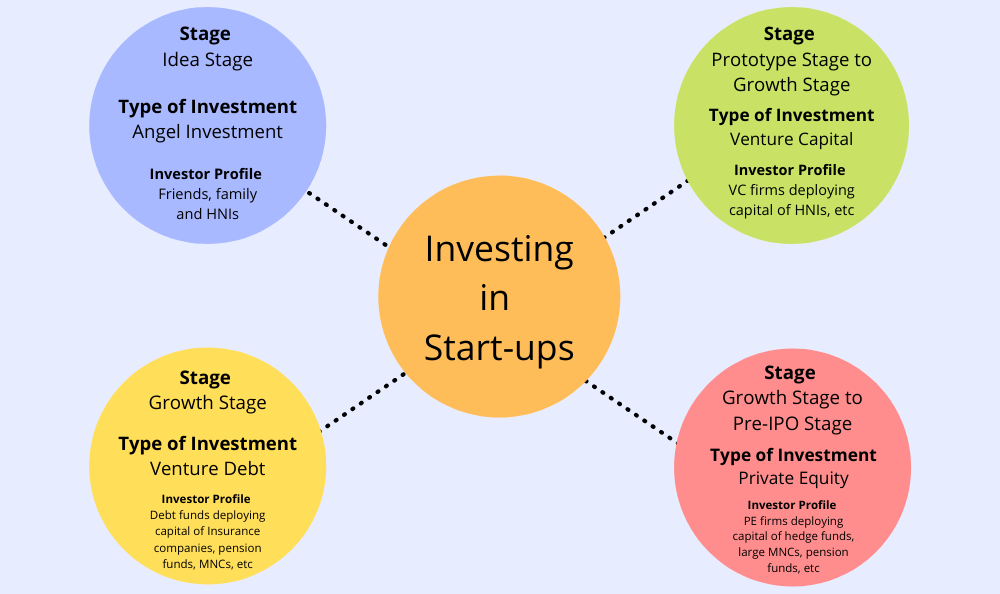
Portfolio Strategy & Risk Management
Even if you make direct bets, your strategy must treat startup investing like a venture portfolio — high variance, long time horizon, and strong downside risks.
Here are several rules of thumb:
- Start Small, Limit Exposure
Only allocate a small portion (e.g. 5–15%) of your total investable capital to direct startup deals. The rest can remain in safer or more liquid assets. - Diversification & Multiple Bets
Expect most deals to fail. The winners (if any) must compensate for the losers. Aim for 8–15 independent deals, across domains and stages. - Staged Investing / Tranche Approach
Commit capital in stages (milestone-based). Don’t give all your capital at once. You can invest more in winners. - Use Co-investment / Syndicates
Partner with experienced angels or join syndicates. That lets you piggyback on due diligence and reduce risks. - Maintain Liquidity Buffer
Because your startup investments might be illiquid for years, keep enough reserves elsewhere in liquid assets. - Rebalance Over Time
As startups mature, re-evaluate — cut failing ones, double down on promising ones (if allowed), adjust allocations. - Adjust Expectations & Time Horizon
Realize that returns (if any) come after 5–10 years. Be mentally prepared for zero return or total loss in many deals. - Exit Planning
For each deal, think early: at what valuation, to whom (acquirers), or via IPO would you exit? That helps evaluate viability.
Practical Steps to Get Started (for a Small Investor)
Let’s put theory into action. Here’s a step‑by‑step guide for a small investor starting today:
1. Self‑Assessment & Capital Allocation
- Decide how much capital you can risk (that you’re okay losing).
- Reserve this for startup or high-risk investments — don’t use emergency funds.
- Decide your indirect vs direct split (e.g., 70% indirect, 30% direct).
2. Educate Yourself & Build Network
- Read relevant AI/ML, startup investing, and technology blogs, papers, and reports.
- Join local or online angel networks, startup meetups, AI conferences.
- Follow AI researchers, startup founders, and VC blogs.
3. Join Platforms & Syndicates
- Register on platforms like AngelList, SeedInvest, Republic (where available in your country).
- Follow AI / deeptech syndicates and get notified of new deals.
- Participate in demo days or accelerator pitch sessions.
4. Screen & Filter Deals
- Use the due diligence checklist above to pre-filter opportunities.
- Focus on deals where terms, traction, team and tech are promising.
- Ask for the pitch deck, financial model, customer contracts, and technical architecture.
5. Conduct Deeper Due Diligence
- Have experts (technical advisors, domain experts) help you evaluate model, code, feasibility.
- Validate customer references, trial deployments, pilots.
- Scrutinize financials, burn, runway, capitalization table, legal documents.
6. Negotiate & Invest (or Decline)
- Negotiate favorable terms (cap, valuation, liquidation preferences, investor protections).
- If comfortable, commit a modest tranche (say 10–20% of what you plan to commit long term).
- Use SAFEs or convertible notes if that’s the structure offered.
7. Post-Investment Monitoring & Support
- Stay engaged — ask for monthly or quarterly updates.
- Offer help (networking, domain contacts, recruiting) when possible.
- Keep assessing whether to invest further or stop backing.
8. Exit & Realization
- Be patient. Most returns arise via acquisition or IPO after many years.
- Understand rights (liquidation, pro-rata, follow-on) when exit events come.
- Reinvest returns into new deals or redistribute to safer assets.
Challenges, Risks & How to Mitigate
It’s crucial to remain realistic. Here are common pitfalls and how to guard against them:
| Risk / Challenge | Description | Mitigation / Strategy |
| High failure rate | Most startups fail or return zero | Diversify widely; invest small; reserve capital for follow-ons |
| Illiquidity & long time horizon | Capital locked for years | Maintain a separate liquid portfolio; treat it as long-term capital |
| Overvaluation / hype bubbles | Valuations can be inflated based on hype, not fundamentals | Push back on unrealistic valuations; demand proof points |
| Technical execution risk | AI is hard technically; many models don’t scale | Prioritize teams with strong ML/AI track record; verify prototypes |
| Market timing & adoption risk | The market may not accept the solution | Check early pilots, customer feedback, market feedback |
| Dilution & future rounds | Your stake may shrink in future fundraising | Ask for anti-dilution protection; invest in follow-on rounds if viable |
| Regulatory / compliance issues | AI involves privacy, bias, legal risks | Insist on the startup having compliance / legal planning |
| Information asymmetry / lack of transparency | You may not see internal challenges or bad decisions | Use well‑connected syndicates, demand transparency in metrics |
As one resource warns, investing in AI startups is not for the faint-hearted. Howik+1
Also, some voices in investor communities caution: “Stop dreaming. Invest in monthly cash scheme or dividend stocks” — because many small investors overestimate their chance of picking winners. Reddit
So, humility and realism are your friends here.
Illustrative Example (Hypothetical Case Study)
Let’s imagine a small investor, Sarah, who wants to allocate $10,000 toward AI startup exposure.
- She decides 70% in indirect (ETFs / public AI) → $7,000
- The remaining 30% → $3,000 goes into direct startup investing
Sarah finds a vetted AI startup in a syndicate, with a minimum commitment of $1,500. She co-invests.
She also keeps $1,500 in reserve to invest in a follow-on round if things go well, but doesn’t commit unless key milestones are met (e.g. reaching 100 paying customers).
Sarah monitors quarterly metrics, remains networking, and after 7 years, the startup gets acquired. Her small stake turns into a modest multiplier on her $1,500. Perhaps not life-changing, but validates her approach. Meanwhile her indirect holdings in AI ETFs appreciated with the broader AI uptrend.
This kind of hybrid exposure gives her both safety and upside.
Tips & Best Practices from Experienced Investors
- Leverage expert networks: Use AI/ML experts to review technical claims.
- Always negotiate terms: Especially in early rounds — valuation cap, liquidation preferences, pro-rata, etc.
- Clarity on milestones: Insist on clear milestones and tranche-based funding.
- Prefer alignment: Invest in founders who are aligned — e.g. putting skin in the game, partial salary, etc.
- Don’t follow the hype blindly: Many AI startups today are just “ChatGPT wrappers” with weak differentiation. Scrutinize the core innovation behind the branding.
- Stay updated on AI trends: So you can spot structural shifts (e.g. LLM architectures, inference cost reductions, domain-specific AI).
- Use data and models: Emerging research uses AI/LLM models to predict startup success based on public descriptions. arXiv
- Be patient and avoid “FOMO”: Early-stage venture is a marathon, not a sprint.
Emerging Trends in AI Startups Worth Watching
If you want to stay ahead as a small investor, you should actively track where AI is evolving. Not all trends are equally investable — but understanding them helps you spot legitimate startups vs hype-driven ones.
Here are a few areas where the most promising AI startups are emerging:
1. Vertical AI (Industry-Specific AI Startups)
Rather than building general-purpose platforms, these startups focus on niche domains where AI can create deep value.
Examples:
- LegalTech AI – Document review, contract automation (e.g. Spellbook, Harvey AI)
- Healthcare AI – Radiology, diagnostics, drug discovery (e.g. Owkin, Paige)
- Construction AI – Site monitoring, BIM analysis (e.g. Buildots)
- Finance AI – Fraud detection, quant models, credit scoring
- Retail AI – Demand forecasting, dynamic pricing, inventory automation
🧠 Investor insight: Domain-specific AI tends to outperform generic solutions due to tailored datasets and less competition.
2. Agentic AI & Autonomous Workflows
These are systems that go beyond answering questions — they act. AI agents can browse the web, operate apps, write code, schedule meetings, etc.
- Open-source ecosystems like AutoGPT, LangChain, and CrewAI are enabling new classes of startups
- Businesses are building AI “workers” for customer support, research, ops, etc.
🧠 Investor insight: Look for startups turning these frameworks into commercial tools with measurable ROI.
3. AI Infrastructure & Model Optimization Startups
Not all AI startups are building apps. Many are solving foundational problems — model compression, inference speed, data pipelines, compute cost, etc.
Hot areas:
- GPU orchestration
- Fine-tuning and distillation tools
- Model monitoring / observability
- Privacy-preserving ML
- Low-latency inference for edge devices
🧠 Investor insight: These B2B plays may not be “sexy,” but they’re often the picks-and-shovels of the AI gold rush.

4. AI for Code and Developer Tools
Startups helping developers write, test, and deploy software faster using AI are booming.
Key players: GitHub Copilot (Microsoft), Cody (Sourcegraph), Replit AI, Tabnine — and dozens of emerging startups in testing, CI/CD, debugging, etc.
🧠 Investor insight: The biggest returns here will come from startups that integrate deeply into workflows, not just copy ChatGPT into an IDE.
Legal and Regulatory Landscape in AI Investing
Investing in AI startups also means understanding legal and compliance implications. Here are the key areas to know:
1. Accreditation Rules (U.S. and Elsewhere)
- In the U.S., SEC rules limit certain private investments to “accredited investors”
- Accredited = $1M net worth (excluding home) or $200k income for 2 years
- Crowdfunding laws (Reg CF) allow non-accredited investors in small amounts
- Always check local laws in your jurisdiction before participating
🧠 Tip: Platforms like Republic and SeedInvest are built around compliant offerings for non-accredited investors.
2. AI-Specific Regulation & Compliance Risk
Startups using AI must comply with:
- Data privacy laws (GDPR, CCPA, HIPAA, etc.)
- Copyright & fair use (training data legal issues)
- Bias & fairness standards (especially in hiring, lending, healthcare)
- AI Act (EU) – First comprehensive AI regulation (expected to roll out 2025–2026)
🧠 Investor red flag: Avoid startups that train on unauthorized data, ignore bias issues, or lack legal counsel.
3. Intellectual Property (IP) Issues
Some AI startups don’t own their models — they just plug into APIs (e.g. OpenAI, Anthropic). That means:
- No true tech moat
- Vendor dependency risk
- Legal gray areas around content generation
🧠 Tip: Ask startups who owns their model weights, data pipelines, and how they plan to handle copyright or liability.
Common Mistakes Small Investors Make in AI Startup Investing
To protect your capital and maximize your learning, avoid these frequent errors made by first-time startup investors:
❌ 1. Investing Based on Hype, Not Substance
AI is the buzzword of the decade — but a wrapper around GPT-4 with no business model is not investable. Always look for defensibility and traction.
❌ 2. Betting Too Big, Too Soon
Many small investors throw $10k–$50k into their first deal without realizing the high failure rate. Start smaller. Spread risk.
❌ 3. No Diversification
One or two startup bets is not a portfolio — it’s a gamble. You need 8–15 startup positions to benefit from the power law.
❌ 4. Not Reading the Legal Documents
SAFEs, notes, cap tables — you must understand what you’re buying. Or hire someone who does.
❌ 5. Not Asking Tough Questions
Founders love storytelling. But you need to play skeptic: ask about unit economics, technical bottlenecks, team gaps, dilution risk.
❌ 6. Impatience
Even great startups take 5–10 years to exit. If you expect returns in 18 months, this isn’t the right asset class.
Resources and Tools for Small Investors to Learn and Track AI Startups
Knowledge is your greatest edge as a small investor. Here’s a curated list of learning and deal-sourcing resources:
🎓 Learning Platforms
- Coursera / DeepLearning.ai – Intro to AI/ML (Andrew Ng’s courses)
- Google Cloud AI Training – Practical AI workflows
- Books – “AI Superpowers” (Kai-Fu Lee), “Prediction Machines,” “The Lean Startup”
- Podcasts – “Invest Like the Best,” “a16z podcast,” “Hardcore AI”
💼 Deal Platforms (for direct investment)
- AngelList
- Republic
- SeedInvest
- Wefunder
- Forge Global
📈 Research & Trends
- CB Insights – AI funding rounds & reports
- Crunchbase – Track specific startups
- [PitchBook] (subscription) – Deeper VC data
- GitHub Trending – Track open-source AI projects
👥 Networks & Communities
- IndieHackers AI
- Twitter / X AI Lists
- [LinkedIn AI groups]
- [AI Slack communities] (e.g. MLOps Community, Cohere Discord)
- Product Hunt AI launches
Final Recap & Action Plan: Your AI Investing Blueprint
Here’s a simplified action plan to wrap everything together and help you start today:
| Step | Action |
| ✅ Step 1 | Allocate a fixed “risk capital” budget (e.g. 5–10% of total investments) |
| ✅ Step 2 | Open accounts on Republic, AngelList, Wefunder |
| ✅ Step 3 | Buy small positions in AI-focused ETFs or public stocks |
| ✅ Step 4 | Join 1–2 AI startup syndicates (AngelList, VC newsletter deals) |
| ✅ Step 5 | Attend demo days or online pitch events (YC, Techstars, university labs) |
| ✅ Step 6 | Use a checklist to evaluate AI startup pitches you see |
| ✅ Step 7 | Make your first small direct investment (e.g. $500–$1,500) in a vetted deal |
| ✅ Step 8 | Stay active — track KPIs, learn, ask for updates, and watch how it plays out |
| ✅ Step 9 | Gradually scale up, diversify, and refine your approach |
Final Thoughts
Investing in AI startups as a small investor isn’t just possible — it’s more accessible than ever. You don’t need to be a Silicon Valley VC to get started. But you do need to approach it with discipline, knowledge, and patience.
To recap:
- Start with what you can afford to lose
- Combine indirect and direct investments
- Learn constantly and follow real tech, not hype
- Back teams who know their domain and have real traction
- Diversify — and think like a portfolio manager, not a gambler
FAQs:
Can I invest in AI startups if I’m not an accredited investor?
Yes, you can — but your options may be limited compared to accredited investors. Platforms like Republic, SeedInvest, and WeFunder allow non-accredited investors to back startups under Regulation Crowdfunding (Reg CF). These platforms offer vetted deals with lower minimums (sometimes as low as $100), making it easier for small investors to gain exposure.
What’s the minimum amount needed to invest in an AI startup?
It depends on the investment route:
Crowdfunding platforms: $100–$500 minimum
AngelList syndicates: $1,000–$5,000 per deal (varies)
Direct angel rounds: Often $10,000+ per investment
ETFs or public AI stocks: No minimum beyond share price
Start small — even a $500–$1,500 investment can help you learn the ropes before scaling up.
How do I know if an AI startup is legit or just using buzzwords?
Do proper due diligence. Watch for:
Founders with real AI/ML backgrounds (e.g., PhDs, published papers)
A clear technical advantage (not just an OpenAI API wrapper)
Evidence of customer traction, pilots, or revenue
A defensible moat (e.g., proprietary data, unique algorithms)
🚩 Red flags: Generic pitch decks, no demo, vague use cases, overhyped claims, no paying users.
How long will it take to see returns from an AI startup investment?
AI startup investments are illiquid and long-term. Most returns (if any) take 5–10 years via:
Acquisition by a larger company
Initial Public Offering (IPO)
Secondary market sale (less common)
Many startups fail. Investors should be patient and view startup investing as a high-risk, long-term play, not a quick profit scheme.
What are the biggest risks when investing in AI startups?
The key risks include:
Startup failure (most early-stage companies don’t succeed)
Illiquidity (your money is tied up for years)
Hype-driven overvaluation (buying in at inflated prices)
Legal or ethical issues (data misuse, AI bias, regulation)
Technical execution risk (the AI doesn’t scale or work reliably)