
Have you ever wondered how societies organize themselves, enforce rules, or manage conflicts? At the heart of those questions lies a fundamental concept in political science: the state. But what exactly is a “state,” and how do scholars approach it? In popular talk, “state” and “government” are often used interchangeably—yet in political science, the distinction is vital.
In this guide, we will unpack:
- The various definitions of the state
- Its essential elements (population, territory, government, sovereignty)
- Classic and modern theories about how states arise and why they endure
- Key functions and challenges states face
- Varieties of states (unitary, federal, failed, emergent)
- Contemporary debates (globalization, legitimacy, digital states)
By the end, you’ll have a richer, more nuanced understanding of what the state means—and why it matters in politics.
1. Defining the State: Core Perspectives
One of the striking things about political science is that there is no single universally accepted definition of the state. Rather, scholars emphasize different aspects depending on their theoretical lens. Let’s review the major definitions and their implications.
1.1 Classical and institutional definitions
- Max Weber’s definition is among the most cited: a state is a “human community that (successfully) claims the monopoly of the legitimate use of physical force within a given territory.”
- Key elements in Weber’s framing: monopoly on legitimate force, territory, legitimacy.
- Key elements in Weber’s framing: monopoly on legitimate force, territory, legitimacy.
- According to Encyclopedia.com, the state is a distinct set of institutions that make and enforce rules — for example, military, judiciary, bureaucracy — and is differentiated from society at large. Encyclopedia
- Britannica highlights that states are distinguished from other social groups by their purpose (order and security), methods (laws and enforcement), territory, and sovereignty. Encyclopedia Britannica+1
These institutional or “structural” definitions emphasize the legal, coercive, and organizational aspects of statehood.
1.2 Functional / sociological definitions
Some definitions emphasize what states do rather than just their structure:
- A state is the organization that maintains public order, provides security, and adjudicates disputes.
- From the Global Policy Forum: a state is more than a government; it endures beyond regimes, levies taxes, operates a military, and redistributes resources. Global Policy Forum
- Didier Fassin (in What Is a State?) invites a more anthropological angle: study how states are experienced, how their authority is manifested at everyday levels. Institute for Advanced Study
1.3 Contractarian, Marxist, “predatory” perspectives
Beyond institutional views, different schools of thought understand the origin, purpose, and logic of the state differently:
- Contractual/contractarian theory (e.g. Hobbes, Locke, Rousseau) sees the state as emerging from a social contract: individuals surrender some freedoms in exchange for protection, order, and common rules.
- Marxist or class-based theories treat the state as a tool of class domination: the state arises where class antagonisms cannot be resolved peacefully, acting to mediate and enforce the interests of dominant classes.
- Predatory or “state as racketeer” theories (e.g. Charles Tilly) portray the state as an entity that “sells protection” (from itself) and extracts revenue from its population—suggesting inherently coercive dynamics.
Thus, depending on your lens, a state might be a guarantor of rights and order, or an instrument of power and extraction.
1.4 Why no single consensus?
Walter Scheidel and others point out that common elements in mainstream definitions tend to include:
- Centralized institutions imposing rules
- Backed by coercion
- Over a defined territory
- Distinguishing rulers from ruled
- Some autonomy, differentiation, legitimacy
But exactly how one weighs “legitimacy,” or “coercion,” or how much autonomy is needed, differs across theories. The debates continue, especially as new phenomena (cyberspace, transnational organizations) challenge traditional state boundaries.

2. Elements (or Ingredients) of a State
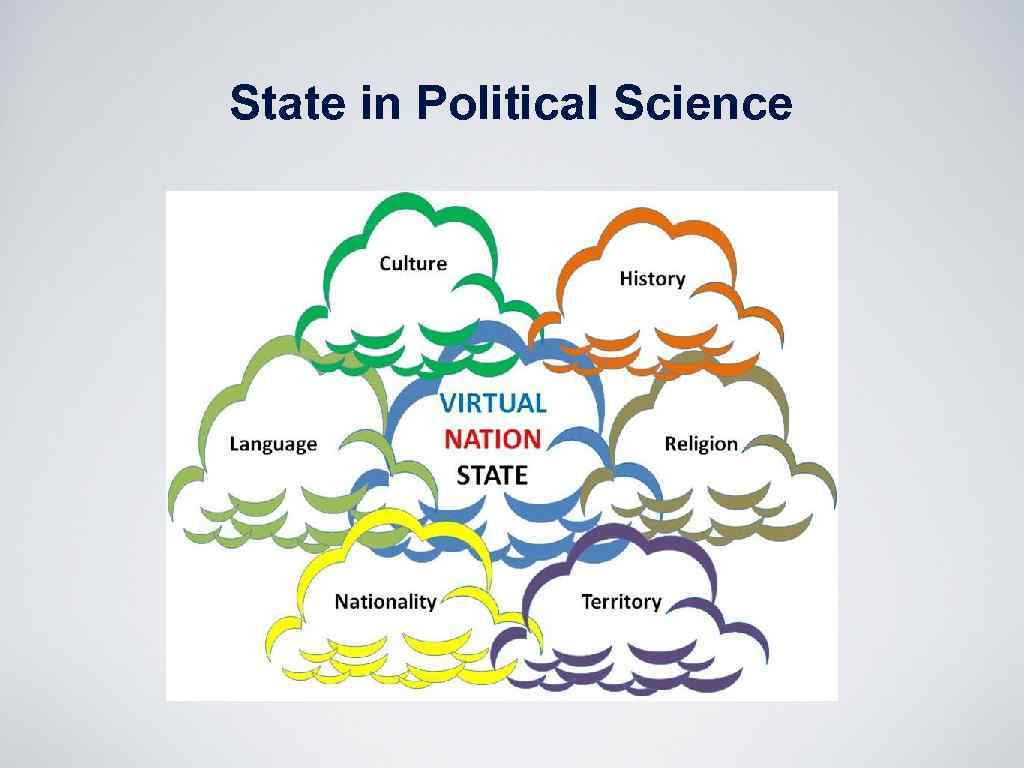
Despite theoretical divergences, political scientists commonly agree on four essential elements that any state must have. Think of them as the minimum conditions for statehood.
| Element | Definition | Why It Matters | Potential Challenges |
| Population | A group of people residing within the territory, bound by political allegiance | Without people, there is no community to govern | Population may be heterogeneous in ethnicity, religion, identity; migration raises challenges |
| Territory | A defined geographical area with boundaries | The state’s authority is spatially limited | Territorial disputes, boundaries in flux, contested lands |
| Government | The institutional machinery through which authority is exercised | The “agent” through which the state acts | Questions over legitimacy, competence, fragmentation |
| Sovereignty | Supremacy of authority within territory, free from external interference | Distinguishes the state from subordinate or dependent entities | Globalization, intervention, loss of autonomy |
Let’s examine each more deeply.
2.1 Population
A state must have people. But it is not enough to have mere numbers—those individuals should have some collective political identity or subject‑state relationship. The state demands allegiance, taxes, rights, and obligations from its population.
Challenges:
- States today often contain multiple ethnic, linguistic, or religious groups, which complicate the notion of a unified “people.”
- In border regions, populations may straddle territories, leading to tensions.
- Migration (immigration and emigration) affects how states define membership, citizenship, and rights.
2.2 Territory
States exercise authority within spatial boundaries—not everywhere on Earth. These boundaries may include land, airspace, water, and in some modern debates, digital domains.
Challenges:
- Border disputes, territorial secessions, and contested zones (e.g. Kashmir, Crimea) blur the neatness of boundaries.
- Some states (e.g. small island states) have minimal land but still operate as fully sovereign states.
2.3 Government (Institutional Organization)
The government refers to the formal institutions (executive, legislature, judiciary, bureaucracy) that wield state power. The state is often thought of as the “container”, whereas the government is the agent or manager.
Important distinctions:
- The government is changeable (elections, coups), but the state is more enduring.
- A state may contain multiple levels of government (central, regional, local).
- Internal struggles often arise within state institutions over policy, priorities, or power.
2.4 Sovereignty
Sovereignty is the most contested and philosophically rich element: it means the state is the ultimate authority in its territory, not subject to any external power.
Two dimensions:
- Internal sovereignty: No domestic body (e.g., rival warlords) can override the state’s authority.
- External sovereignty: The state is not legally subordinate to other states or supranational authorities.
Challenges:
- Globalization, international organizations, treaty obligations may limit a state’s autonomy.
- For weak or fragile states, internal sovereignty may be fragmented—areas where nonstate actors hold de facto power.
- The rise of digital governance, extraterritorial financial systems, and cyber threats complicates what sovereignty means in practice.
3. Functions and Roles of the State
Understanding what a state is is one thing; understanding what it does is another. Consider the state as a problem-solving institution: it arises to fulfill certain societal needs. Below are core functions of the state and insights into how effectively states perform them.
3.1 Maintaining order, security, and the rule of law
One of the most fundamental roles: enforce rules, adjudicate disputes, beat back disorder, protect citizens from internal threats (crime, violence). In many ways, legitimacy hinges on this. If a state cannot ensure basic security or rule of law, citizens lose faith.
3.2 Defense and external security
States protect their borders, maintain armed forces, and engage in diplomacy. External defense is part of what makes sovereignty meaningful.
3.3 Public goods and infrastructure
States often provide services that markets may under-provide: roads, bridges, education, public health, sanitation, utilities. These strengthen social welfare and economic development.
3.4 Welfare, redistribution, and social justice
Many modern states have roles in redistribution (taxation, social security, welfare), aiming to reduce inequalities, provide safety nets, and intervene in markets to correct failures.
3.5 Regulation and governance of markets
States regulate commerce, set property rights, enforce contracts, control monopolies, oversee financial systems, issue currency, etc. Without some state structure, large-scale markets would struggle to coordinate.
3.6 Legitimacy, identity, and symbolic functions
States also perform symbolic and integrative roles: forging national identity, maintaining rituals, and legitimating authority. Monuments, flags, narratives — all part of the state’s soft power.
3.7 Crisis management and adaptation
States must navigate crises—economic downturns, pandemics, environmental disasters, war. Their capacity to adapt, mobilize resources, and respond effectively often determines their survival.
A note on performance
Not all states perform these functions equally well. A failed state is one where the state has lost control over significant portions of its territory, cannot provide basic services or security, and the monopoly of violence is broken.
4. Types and Classifications of States
As we move from theory to real-world variation, states differ in structure, power, legitimacy, and stability. Let’s survey major classifications.
4.1 Unitary vs. federal states
- Unitary state: Power is centralized. Local governments (if any) operate at the behest of the central government. e.g. France, Japan.
- Federal state: Sovereignty is constitutionally divided between central and regional units. e.g. United States, India, Germany.
The choice often reflects size, diversity, and historical factors.
4.2 Presidential, parliamentary, and hybrid systems
These refer to how executive-legislative relations are structured:
- Presidential: The president is separately elected, serves as both head of government and state, with separation of powers (e.g. USA).
- Parliamentary: The executive (prime minister) is drawn from the legislature and is accountable to it (e.g. UK, Canada).
- Hybrid or semi-presidential: Combines elements (e.g. France, Pakistan) where there is a president and a prime minister sharing power.
4.3 Strong vs. weak states
- Strong state: Stable institutions, capacity to collect taxes, enforce laws, provide services across territory.
- Weak or fragile state: Limited control, institutional gaps, internal conflict, lack of legitimacy.
4.4 Failed, collapsed, or fragile states
When state institutions break down, you encounter:
- Failed states: Loss of effective sovereignty and authority (e.g. Somalia).
- Collapsed states: State essentially disappears as a functioning entity.
- Fragile states: On the cusp, with recurrent crises, institutional weakness, or frequent political instability.
4.5 Nation-state, multiethnic states, supranational states
- A nation-state aligns political boundaries with cultural or national identity (e.g. Japan).
- Many states are multiethnic or plurinational (e.g. India, Nigeria) — requiring complex governance to manage diversity.
- Supranational states or supranational organizations (like the European Union) challenge traditional sovereignty by ceding authority upward.
5. Theories of State Formation and Change
Understanding how states emerge and evolve helps explain power dynamics and institutional trajectories.
5.1 Social contract tradition
As mentioned earlier, theorists like Hobbes, Locke, and Rousseau viewed state formation as a bargain: individuals cede some rights to achieve security and order. The legitimacy of authority hinges on consent or general will.
5.2 Historical/emergent theories
States emerge gradually through war-making, administrative innovations, elite bargains, coercion, and institutionalization—often messy and evolutionary rather than neatly planned.
- Charles Tilly famously quipped, “War made the state, and the state made war”: rulers consolidated territory, collected taxes, created armies.
- State-building in postcolonial contexts often faces challenges of legitimacy, extraction, capacity, and external interference.
5.3 Marxist / class theories
From Marxist or neo-Marxist perspectives, the state is not neutral: it is the instrument through which dominant classes enforce their interests. The state is the locus of class struggle, mediation, and control.
5.4 Predatory state theory
This view sees states as extortion mechanisms: rulers extract resources, in exchange provide security—but often the extractive function overshadows benefits, and resistance or collapse can ensue.
5.5 Institutional and path‑dependency theories
This lens emphasizes how historical choices, institutional layering, and feedback loops create path dependency—i.e. once a state builds certain institutions, they condition future possibilities. Reform is hard, due to legacies.
5.6 Globalization and diffusion
In modern times, states are shaped by external pressures—global norms, international organizations, transnational networks, treaties, global economy. States adopt institutional models from peers (diffusion) while facing constraints on autonomy.
6. State vs. Government vs. Society vs. Nation: Clarifying the Distinctions
One common source of confusion is conflating state, government, nation, and society. Let’s clarify:
- State: A political organization with institutions, sovereignty, territory, and authority.
- Government: The apparatus (executive, legislature, courts, bureaucracy) that manages state functions.
- Nation: A group of people sharing identity, culture, history, language—does not necessarily imply sovereignty.
- Society: The realm of associations, norms, civil life, culture, nonstate actors outside the official coercive apparatus.
In other words:
- The state is the institutional shell;
- The government is its current occupant;
- The nation is an identity claim;
- Society is the sphere of civil interaction.
An example: In the United States, the state is the abstract sovereign entity; the government is the Biden administration (or whoever holds office); the American nation is a shared identity; and society includes NGOs, communities, religious groups, civil associations.
Many political disputes arise when societal actors challenge or influence the state or when the state encroaches on society.
7. Contemporary Challenges and Debates
The traditional model of the state—territorial, sovereign, coercive—faces pressure from multiple directions. Here are key challenges and debates:
7.1 Globalization and loss of state autonomy
States now confront transnational corporations, capital flows, supranational bodies (EU, WTO), and international norms. These external pressures limit the discretion of states, especially in economic policy, regulation, and sovereignty.
7.2 Erosion of legitimacy and trust deficits
In many democracies, trust in institutions is declining. When citizens see corruption, weak rule of law, unaccountable elites, the legitimacy of the state is at stake.
7.3 Digital states and cyber‑sovereignty
The rise of e‑governance, digital infrastructure, data sovereignty, and cybersecurity is transforming how states operate. States must now protect not just physical territory but digital spaces, citizens’ data, and online institutions.
7.4 Nonstate actors and hybrid authority
In some regions, nonstate actors (militias, gangs, NGOs, religious groups) fill governance gaps—leading to hybrid authority. This challenges the neat monopoly model of statehood.
7.5 Fragility, failure, and collapse
Some states oscillate between stability and crisis. Fragile states can regress—institutions collapse, leaders become predatory, conflict rises.
7.6 Constitutionalism, multilevel governance, and devolution
In response to pressures of scale, diversity, and demand, many states devolve power, adopt federal arrangements, or engage in multilevel governance. The tension between centralization and decentralization is perennial.
7.7 Normative debates: justice, inclusion, rights
Modern political theory is pushing states to expand their role in promoting social justice, inclusion, human rights—raising questions about limits, coercion, and legitimacy.

8. Case Studies & Illustrations
To ground these concepts, let’s briefly look at a few real-world illustrations:
8.1 Nigeria: a case of federalism, fragility, and diversity
Nigeria is an example of a federal state grappling with ethnic diversity, regional cleavages, and institutional weakness. Though formally sovereign and structured, internal challenges—ethno‑religious conflict, corruption, weak rule of law—strain the legitimacy of the state.
8.2 Somalia: a failed or collapsed state
After years of civil war and institutional collapse, Somalia lost effective control over many regions. The central state’s monopoly on force is largely absent, with warlords and clan militias exercising de facto authority.
8.3 European Union: encroaching supra‑state authority
While the EU is not itself a state, it shows how member states cede sovereignty to supranational institutions. EU member states accept limitations on their policy autonomy (e.g. monetary, regulatory) in exchange for shared benefits. This blurs traditional notions of external sovereignty.
8.4 Digital governance in Estonia
Estonia is often cited as a model of a “digital state”—offering e-residency, online services, digital voting, and administrative transparency. It illustrates how states can reinvent their institutional models to align with technology.
9. Why This Topic Matters (and How You Can Apply This Knowledge)
Understanding what a state is is foundational for many fields:
- For students: foundational in comparative politics, international relations, political theory.
- For policy analysts and practitioners: designing reforms, constructing institutions, evaluating state capacity.
- For citizens: discerning the legitimacy and limits of state power, rights and obligations, accountability.
- For activists and reformers: diagnosing state dysfunction, proposing institutional change, contesting power.
Here are a few ways to apply this knowledge:
- Evaluate a country’s capacity: is it a strong, weak, or fragile state?
- Interpret political reforms: federalizing, devolving power, constitutional amendments.
- Assess legitimacy debates: social contract, representation, trust.
- Understand global pressures: trade agreements, foreign intervention, transnational justice.
- Project future trajectories: how might digital governance or climate challenges reshape states?
10. Summary & Key Takeaways
- There is no one single definition of the state in political science. Different scholars emphasize institutional, functional, social contract, or critical dimensions.
- Most definitions converge on certain core elements: population, territory, government, sovereignty.
- States perform crucial functions—security, public goods, regulation, legitimacy, identity—and their success depends on capacity, legitimacy, and adaptability.
- Real-world variation is vast: unitary vs federal, strong vs weak, collapsed vs emergent, digital vs traditional.
- Theories of state formation—from contractarian to Marxist to institutional—offer competing lenses through which to analyze power, origin, and inequality.
- Contemporary challenges (globalization, legitimacy crises, digital realms, hybrid governance) are testing classical ideas of sovereignty and statehood.
11. The Evolution of the Modern State
While the idea of a state has existed for centuries, the modern state — with bureaucracies, professional militaries, and defined citizenship — is a relatively recent phenomenon. Let’s trace a brief historical evolution to understand how we arrived at today’s system of states.
11.1 Pre-modern states and empires
Before modern states, power was often held by empires, city-states, or feudal lords:
- City-states like Athens or Sparta had sovereign governments but were geographically limited.
- Empires (e.g. Roman, Ottoman, Mughal) extended sovereignty over vast territories, often multiethnic, ruled through varying degrees of centralization and local autonomy.
- Feudal systems in medieval Europe had fragmented authority, where kings ruled in name, but real power lay with local lords.
11.2 The Treaty of Westphalia (1648)
Often cited as the birth of the modern international system, the Treaty of Westphalia ended the Thirty Years’ War in Europe and introduced key principles:
- Sovereignty of states over their territory
- Non-interference in the internal affairs of other states
- Legal equality of states in diplomacy
Though not a single cause, Westphalia symbolized a turning point: the consolidation of territorial states with centralized authority.
11.3 Rise of the bureaucratic state
From the 18th to 20th centuries, especially in Europe, states began to centralize administrative control. This meant:
- Regular taxation systems
- Standing armies
- Professional civil services (e.g. Prussia’s bureaucracy)
- National education systems
Modernization theory posits that as societies industrialized, their political systems also rationalized — leading to the “Weberian” state: hierarchical, rule-bound, and impersonal.
11.4 Decolonization and state expansion
The 20th century witnessed a massive wave of decolonization, especially after WWII:
- Dozens of states in Africa, Asia, and the Middle East gained independence from European empires.
- Many adopted state structures modeled on European or Soviet systems.
- Challenges of state-building were immense: drawing borders, building legitimacy, managing ethnic diversity, and establishing governance capacity.
11.5 Contemporary trends: supranationalism, digitalization, decentralization
Today’s states face new transformations:
- Supranational institutions (e.g. EU, IMF, WTO) influence domestic policies.
- Digital technology is reshaping how states provide services, conduct surveillance, or engage citizens.
- Decentralization and devolution in many democracies (e.g. Scotland in the UK, Catalonia in Spain) give more autonomy to subnational units.
12. The Concept of State Legitimacy
A state’s power isn’t just about coercion—it’s about legitimacy: the belief by the population that the state has the right to rule. Legitimacy is a key source of political stability and social cohesion.
12.1 Weber’s three types of legitimacy
Max Weber identified three types of legitimate authority:
- Traditional: Based on long-standing customs, traditions, or hereditary rule (e.g. monarchies).
- Charismatic: Based on a leader’s personal qualities or charisma (e.g. revolutionary leaders like Gandhi or Mandela).
- Legal-rational: Based on established laws, rules, and procedures (e.g. modern bureaucratic democracies).
Most modern states strive for legal-rational legitimacy, though elements of the other two persist.
12.2 Factors that build or erode legitimacy
- Rule of law: Citizens believe laws are fair and enforced impartially.
- Democratic participation: Free and fair elections, accountable leaders.
- Service delivery: States that provide security, education, healthcare, infrastructure gain credibility.
- Inclusion and justice: States that recognize minority rights and avoid discrimination are more likely to be seen as legitimate.
12.3 When legitimacy collapses
Legitimacy crises can lead to:
- Protests or mass movements
- Revolutions or regime changes
- Civil war or secessionist conflicts
- International intervention (e.g. humanitarian reasons)
The Arab Spring (2010–2012) is a case where long-standing autocracies lost legitimacy in the eyes of their people—leading to uprisings and in some cases, full-scale regime change or state collapse.
13. The Future of the State: Trends and Predictions
While some commentators in the 1990s predicted the “end of the state”, current realities show that the state remains resilient, though it is adapting.
13.1 Will states disappear?
Not likely.
Despite globalization, states still:
- Control citizenship and legal identities
- Maintain security and order
- Regulate economies
- Act as diplomatic actors in international relations
However, their scope, scale, and tools are changing.
13.2 Rise of digital and “smart” states
We’re entering an era of digital governance, where the state becomes:
- More data-driven: using AI, machine learning, and big data for policy-making
- More efficient: automating services (e.g. digital ID, online tax filing, e-governance)
- More surveillant: tools like facial recognition, predictive policing raise ethical concerns
Examples:
- Estonia is a pioneer of the digital state, with nearly all government services available online.
- China uses digital platforms extensively for surveillance, social credit, and governance control.
13.3 Environmental and climate governance
As climate crises intensify, states are being called on to:
- Regulate emissions and energy transitions
- Respond to natural disasters
- Support climate refugees
- Cooperate on global environmental agreements
States that can adapt to climate change and build resilient infrastructure will fare better in the coming decades.
13.4 Post-liberal and authoritarian resurgence
While liberal democracies face internal challenges, authoritarian states are not disappearing. In fact:
- Some authoritarian regimes (e.g. China, Russia, Saudi Arabia) show strong state capacity.
- There’s a global trend of democratic backsliding, where even democracies erode rights, press freedoms, or judicial independence.
This shows that strong states don’t always mean democratic states — a crucial distinction in political science.
Final Thoughts: Why Understanding the State Still Matters
In a world full of change — from pandemics to digital revolutions, climate threats to authoritarian pushbacks — the state remains one of the most crucial units of analysis in political science.
- It’s where citizenship happens.
- It’s where laws are made and enforced.
- It’s where power is contested, legitimated, or abused.
- It’s what stands between anarchy and order.
As citizens, scholars, voters, or simply curious observers, understanding how the state functions — and malfunctions — is essential to making sense of global and local politics.
Whether you’re analyzing U.S. federalism, questioning surveillance in authoritarian regimes, or exploring new forms of digital governance, the state is at the center of the puzzle.
FAQs:
Is a state the same as a government?
No. A state is the permanent institutional framework (sovereign, territorial, organized), while a government is the current group of officials managing the state. Governments change; states endure.
Can a nation exist without a state?
Yes — the Kurdish people are a nation without a sovereign state. Likewise, Palestinians are often cited in this context. The term stateless nation refers to such groups.
Can a state exist without international recognition?
Yes, de facto. Taiwan functions as a state (it has territory, population, sovereignty), but is not widely recognized diplomatically. International recognition influences participation in global institutions but doesn’t automatically negate statehood.
What is a failed state?
A failed state is one where the government has lost control over territory, cannot provide basic services, or has no monopoly on violence. Examples include Somalia, Yemen, or parts of Libya.
What is a nation-state?
A nation-state is where the boundaries of a state coincide with a nation (shared identity, language, culture). Japan is a classic example. Most states today are multiethnic and not true nation-states.