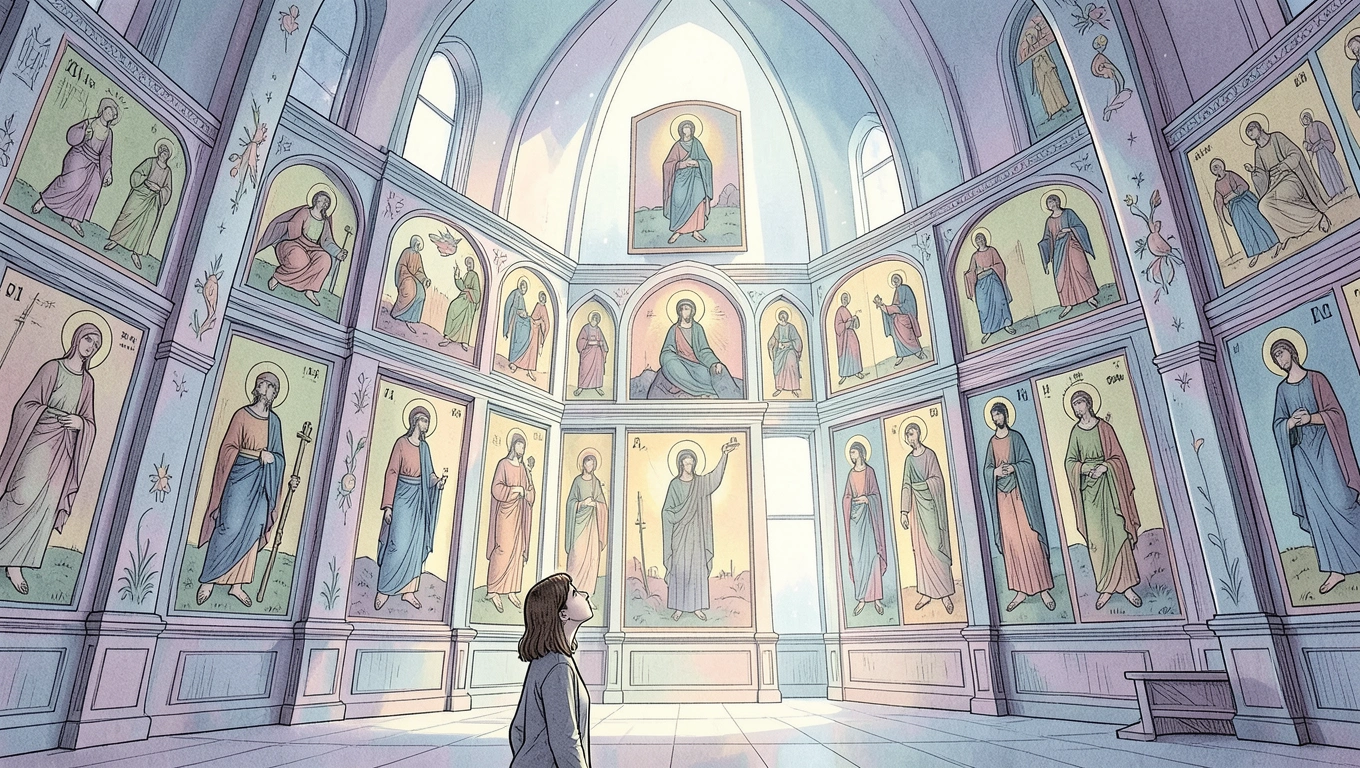
When you first step into an Orthodox church and gaze up at the sacred icons lining the walls, you might feel a jolt of confusion. The faces look almost alien - enormous foreheads, elongated features, eyes that seem to stare through you rather than at you. The Christ Child on Mary's lap appears oddly adult-like, and the whole scene seems to unfold in a space that defies the laws of perspective you learned in school. This isn't poor artmanship. Every seemingly strange element you see follows centuries-old rules designed to communicate something far beyond what a photograph ever could. These images aren't meant to capture how saints looked in life. They're windows into another reality entirely, and once you understand their visual language, you'll never see them the same way again.
Icons Are Written, Not Painted
The first thing to understand is that in Orthodox tradition, artists don't paint icons - they write them. This isn't just a quirky translation issue. Each brushstroke represents a prayer, and the entire process of creating an icon is considered a spiritual discipline rather than merely artistic expression. Iconographers often prepare through prayer and fasting before beginning their work, and they apply colors in a specific spiritual sequence that mirrors the journey from darkness to divine light.
This means the person creating the icon doesn't sign their name. Icons are made anonymously because the goal is to glorify God, not to showcase individual talent or style. When you look at an icon, you're not meant to think about the painter's skill or creative vision. You're meant to encounter the person or event being represented, transfigured in God's light. The icon itself becomes a prayer aid, an invitation to deeper reflection rather than an object of aesthetic appreciation alone.
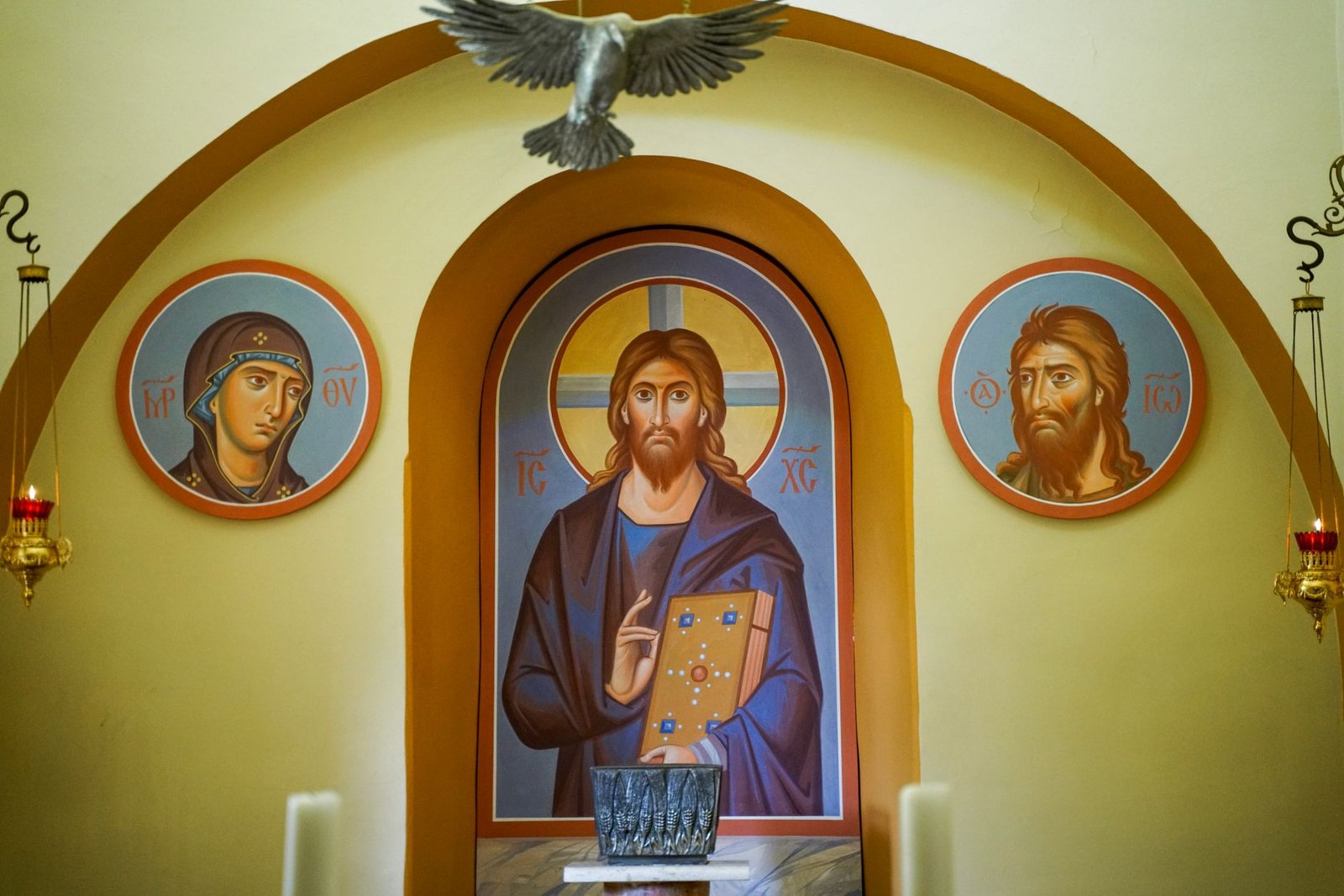
The materials matter too. Traditional icons are built up in layers on wooden panels, often using egg tempera and natural pigments. Gold leaf, which you'll see shimmering in backgrounds and halos, wasn't chosen for its beauty alone. According to the Byzantine Museum in Thessaloniki, gold represents divinity itself - the uncreated light of God that cannot be captured in earthly colors.
Why Faces Look Strange and Symbolic
Those oversized foreheads? They signify wisdom. The deep lines and wrinkles carved into many faces represent accumulated knowledge and spiritual depth. Lips are almost always closed, emphasizing the importance of silence and contemplation over speech. Eyes are large and penetrating because they're meant to invite you into relationship, to hold your gaze and draw you into prayer.
Nothing about these faces is accidental or primitive. Early iconographers knew how to create realistic portraits - Roman and Byzantine art had already mastered naturalism. But icons deliberately reject earthly realism because they're not showing you earthly reality. They're showing you heavenly reality, what a person looks like when transformed by grace. This is why even the Christ Child often appears as a miniature adult rather than a chubby baby. The image communicates that while God truly became human, His divine nature and wisdom were present from the beginning.
The stylization follows disciplined, traditional rules passed down through generations. These aren't random creative choices. They're a spiritual language, carefully preserved so that anyone familiar with it can read the theological truths embedded in the image. When you see a figure with three rays of light emanating from the head, you know you're looking at someone experiencing divine illumination. When you see certain hand gestures, you can identify whether the person is blessing, teaching, or praying.
Reverse Perspective and Heavenly Space
Here's where icons really mess with your visual expectations. Most Western art since the Renaissance uses linear perspective - parallel lines converge toward a vanishing point in the distance, making you feel like you're looking through a window into a three-dimensional space. Icons do the opposite. They use reverse perspective, where elements appear to move toward you rather than recede into the background.
This creates an unsettling effect at first, like the building or throne is tilting forward, about to spill out into your space. But that's exactly the point. You're not supposed to be a passive observer looking at a scene from the outside. The icon is inviting you in, making the spiritual reality present to you, collapsing the distance between your world and the divine realm. The saint isn't trapped in a frame on a wall somewhere far away. The saint is here, now, with you.
You'll notice this especially in the iconostasis - the wall of icons that separates the altar from the main sanctuary in Orthodox churches. These aren't just decorative. They're a visual theology, showing you the communion of saints and making heaven present during the liturgy. The central icons typically feature Christ, the Virgin Mary, and other saints who seem to lean toward you, witnesses and participants in the worship happening in that very moment.
Color as Theological Language
Every color you see carries meaning. Red doesn't just add visual interest - it signifies passion, sacrifice, and rebirth, which is why you often see it in scenes of martyrdom or the resurrection. Green represents the beginning of life, renewal, and growth in holiness. Blue, particularly the deep blue often clothing the Virgin Mary, speaks of heaven and divine mystery. White indicates purity and the uncreated light of God's glory.
These colors are applied in a specific sequence during the icon's creation. Iconographers start with dark base colors and gradually build up to lighter highlights, a process that mirrors the theological understanding of moving from darkness to light, from earthly to heavenly. The final highlights - often gold or pure white - represent the touch of divine grace, the light that shines from within a person transformed by God.
When you understand this color symbolism, you can read an icon more deeply. You can see why certain figures wear certain garments, why backgrounds shift from gold to blue to green, why specific objects are highlighted in red. Nothing is arbitrary. Every visual choice is a theological statement, carefully considered and preserved through centuries of tradition.
Summary
- Icons are written through prayer, not painted for artistic display, and remain unsigned to focus glory on God rather than the iconographer
- Exaggerated features like large foreheads and deep wrinkles symbolize wisdom and spiritual knowledge rather than physical appearance
- Reverse perspective makes the image move toward you, inviting participation instead of distant observation
- Colors carry precise theological meanings - gold for divinity, red for passion and rebirth, green for new life, blue for heaven
- The Christ Child appears as a miniature adult to convey His divine nature and wisdom from birth
- Closed lips emphasize contemplation and silence, while large eyes draw you into relationship and prayer
- Icons function as windows into heaven, showing people transfigured in divine light rather than earthly reality
Final Thought
The strangeness you feel when first encountering icons isn't a bug - it's a feature. These images are meant to jolt you out of your everyday assumptions about how the world works and what spiritual reality looks like. They refuse to let you remain a comfortable, distant observer. They insist that the divine realm isn't somewhere far away or long ago, but breaking into your present moment, available and close.
The tradition of icon painting stretches back to the early Church, with legends tracing the first icon of Christ to Christ Himself. The Seventh Ecumenical Council in 787 affirmed that creating icons wasn't blasphemous but rather a testament to the reality of the Incarnation - God truly became human, truly had a face that could be represented. For first-time visitors, the visual language might feel foreign and disorienting. But give yourself time. Sit with these images. Let them teach you to see differently. The more you understand their grammar and vocabulary, the more eloquent their silence becomes, and the more clearly they fulfill their purpose as prayers in visual form.
Questions?
Why don't icons use realistic perspective like other religious art?
Icons use reverse perspective intentionally to make the image move toward you rather than recede into the background. This invites your participation in the spiritual reality being shown rather than keeping you as a distant observer looking through a window. The goal isn't to create a realistic scene you observe from outside, but to make the divine presence available in your space.
What does it mean that icons are written instead of painted?
Calling the process writing emphasizes that each brushstroke is a prayer and the entire creation is a spiritual discipline. Iconographers prepare through prayer and fasting, apply colors in a spiritually significant sequence, and remain anonymous because the work aims to glorify God rather than showcase individual artistic talent. The icon becomes a form of theological text written in images.
Why does the baby Jesus look like a small adult in icons?
The Christ Child is shown as a miniature adult to convey theological truth rather than physical appearance. This represents the development of God becoming human while maintaining His divine nature and wisdom from the beginning. Icons aren't baby pictures - they're spiritual portraits showing the reality of the Incarnation, that God truly entered human life while remaining fully divine.
Can anyone learn to paint icons or is it only for professionals?
While icon writing requires learning specific traditional techniques and theological principles, beginners can start with simpler compositions. Common starting subjects include the Theotokos (Mother of God), Christ Pantocrator, and Archangels because of their clearer symbolism and less complex compositions. The spiritual preparation - prayer, understanding the theology, and approaching the work with humility - matters as much as technical skill.